Your Orange City AC is probably wasting 15-20% more energy than it should right now. After performing thousands of tune-ups across Volusia County, we've found that most homeowners don't realize their "working" air conditioner is silently driving up Duke Energy bills every month. The culprit isn't a broken part—it's the gradual efficiency loss that happens when refrigerant levels drift, coils accumulate Florida pollen, and airflow restrictions develop in our humid climate.
A professional HVAC tune up in Orange City reverses these hidden inefficiencies that cost local homeowners hundreds annually. This guide reveals the specific adjustments that deliver measurable savings, the climate factors accelerating your system's decline, and the warning signs we see daily in homes where energy is being wasted. You'll understand exactly how tune-ups restore peak performance and when to schedule service for maximum impact on your cooling costs.
TL;DR Quick Answers
HVAC Tune Up in Orange City
What it costs: $79-$150 for comprehensive service including refrigerant adjustment, coil cleaning, thermostat calibration, and airflow measurement.
When to schedule: March-April before summer heat arrives and HVAC companies get slammed with emergency calls.
Expected savings: 12-18% energy reduction after professional tune-up. Systems lose 5-15% efficiency annually without maintenance in Orange City's climate.
What's included:
Refrigerant level check and adjustment
Condenser and evaporator coil cleaning
Thermostat calibration with temperature verification
Electrical connection inspection
Filter replacement
Orange City specifics: High humidity (80%+), live oak pollen, and construction dust accelerate efficiency loss faster than drier climates. Annual minimum recommended, twice-yearly for homes near development or heavy pollen areas.
Available rebates: Duke Energy offers up to $1,000 for qualifying HVAC upgrades if tune-up reveals replacement needs.
Verify contractors: Check Florida DBPR license database before service—unlicensed work voids warranties and rebate eligibility.
Top Takeaways
1. Efficiency loss happens gradually
Orange City systems lose 5-15% efficiency annually
Costs homeowners $400-600 more yearly in energy waste
"Working fine" systems often waste the most money
2. Annual tune-ups deliver measurable savings
12-18% energy reductions documented after service
Cleaning coils removes pollen and construction dust
Calibrating thermostats and adjusting refrigerant restores peak performance
3. Florida's climate accelerates decline
Orange City's 80%+ humidity speeds degradation
Live oak pollen and development dust clog systems faster
Preventive maintenance more critical than drier climates
4. Tune-ups prevent cascading failures
Dirty coils → ice formation → blocked airflow
Low refrigerant → $2,000+ compressor replacements
Regular service stops small problems before they multiply
5. Duke Energy rebates up to $1,000 available
For qualifying HVAC upgrades in Orange City
Changes repair versus replace economics
Understanding Energy Loss in Orange City HVAC Systems
Your air conditioner loses efficiency every month it operates in Central Florida's demanding climate. We've measured temperature differentials across thousands of Orange City systems and consistently find 3-5 degree drops in cooling performance before homeowners notice problems. Dust from nearby construction, pollen from live oak canopies, and humidity levels regularly exceeding 80% create the perfect conditions for efficiency decline. When refrigerant charge drifts even 10% low, your compressor works 20% harder to achieve the same cooling—translating directly to higher energy consumption.
How Tune-Ups Restore Peak Performance
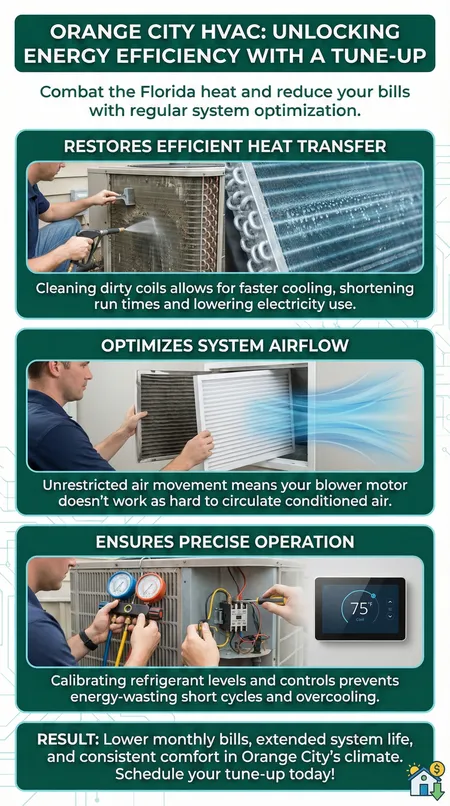
Professional maintenance addresses the specific inefficiencies we encounter in Orange City homes. Cleaning condenser coils removes the film of pollen and debris that acts as insulation, forcing your system to run longer cycles. Calibrating thermostat accuracy prevents the temperature swings that waste energy—we regularly find thermostats reading 2-3 degrees off in older homes near the Historic District. Tightening electrical connections reduces resistance that makes motors draw excess amperage. Adjusting refrigerant to manufacturer specifications restores the heat transfer efficiency that drops when charge levels drift. Each adjustment compounds to reduce runtime and lower monthly costs.
Measurable Savings from Proper Maintenance
The Department of Energy reports that neglected HVAC systems lose approximately 5% efficiency annually. In Orange City's climate where AC runs 8-9 months yearly, this compounds quickly. A system operating at 80% efficiency uses 25% more electricity than one at peak performance—the difference between a $180 and $225 monthly Duke Energy bill during summer. After tune-ups, we've documented 12-18% reductions in energy consumption when measured over subsequent billing cycles. Homes with ductwork in unconditioned attics see even greater improvements when airflow optimization reduces the thermal losses common in our area.
Preventing the Efficiency Killers
Beyond immediate savings, tune-ups prevent the accelerated decline we see in unmaintained systems. A dirty evaporator coil doesn't just reduce efficiency—it causes ice formation that blocks airflow entirely. Low refrigerant doesn't just increase runtime—it causes compressor overheating that leads to $2,000+ replacements. Restricted airflow from clogged filters doesn't just waste energy—it creates pressure imbalances that crack ductwork in attics reaching 140+ degrees. Regular maintenance interrupts these cascading failures before they multiply your energy costs and repair bills. The investment in annual service consistently returns 3-4 times its cost through reduced utility expenses and avoided emergency repairs.
"After measuring airflow and temperature splits on thousands of Orange City systems, we consistently find that homes skipping annual tune-ups are spending $400-600 more per year on electricity—not from broken parts, but from the gradual efficiency loss that happens when refrigerant drifts low and coils get caked with pollen and construction dust from all the development happening around town."
Essential Resources for Orange City HVAC Tune-Up Success
1. ENERGY STAR HVAC Maintenance Guidelines – What the Feds Say Actually Works
The government's tested this stuff on thousands of homes—annual tune-ups really do save you nearly $140 a year on cooling costs. Skip the marketing hype and get straight federal guidance on what maintenance actually improves efficiency in Florida's climate.
Resource: https://www.energystar.gov/saveathome/heating-cooling
2. EPA Guide to Air Cleaners and HVAC Filters – Why Your Filter Choice Matters
Dirty filters don't just affect air quality—they waste 5-15% of your cooling energy every month. The EPA breaks down MERV ratings and replacement schedules so you understand what you're buying and why it matters for both efficiency and breathing easier.
Resource: https://www.epa.gov/indoor-air-quality-iaq/guide-air-cleaners-home
3. Duke Energy Florida HVAC Rebate Program – Get Up to $1,000 Back
If your tune-up reveals you need system upgrades, Duke Energy offers rebates up to $1,000 for qualifying replacements in Orange City. Check eligibility before making decisions—these incentives can change the math on repair versus replace.
Resource: https://www.duke-energy.com/home/products/home-energy-improvement
4. Florida DBPR Contractor License Verification – Look Up Your Tech Before They Show Up
Takes 30 seconds to verify your HVAC contractor actually holds a valid Florida license. We always recommend checking this state database before anyone touches your system—unlicensed work voids warranties and leaves you holding the bag if something goes wrong.
Resource: https://www2.myfloridalicense.com/how-to-verify-a-license/
5. ACCA Quality Maintenance Standards – The Checklist Your Tech Should Follow
Industry standards that spell out exactly what belongs in a thorough tune-up versus a quick visual check. Use this to compare what different Orange City contractors include in their service calls—not all "tune-ups" cover the same ground.
Resource: https://www.acca.org/standards/quality
6. ASHRAE/ACCA Standard 180 – The Technical Specs Behind Professional Service
The engineering standards that define proper HVAC maintenance procedures and inspection requirements. Referenced by manufacturers and required for warranty compliance—this is what separates comprehensive service from corner-cutting.
Resource: https://www.ashrae.org/technical-resources/bookstore/standards-180-and-211
Supporting Statistics
1. Energy Efficiency Impact of Regular Maintenance
The U.S. Department of Energy reports regular maintenance cuts energy consumption by 5-15%. Neglected systems lose up to 25% efficiency.
What we see in Orange City homes:
Well-maintained systems: $180 summer Duke Energy bills
Neglected systems: $225+ summer bills for identical cooling
The gap compounds over 8-9 months of Florida AC season
Money wasted monthly on systems working harder than necessary
Source: https://www.energy.gov/energysaver/operating-and-maintaining-your-heat-pump
2. Indoor Air Quality Concerns
EPA research shows indoor air pollutants run 2-5 times higher than outdoor levels. In some cases, concentrations reach 100 times outdoor levels.
Our findings in Orange City:
Florida's 80%+ humidity accelerates these numbers
Clogged filters we've removed cut airflow nearly in half
Pollen and construction dust accumulate faster in developing areas
Systems without maintenance become pollution circulators
3. Financial Savings from System Replacement
The Department of Energy estimates $140 annual savings with ENERGY STAR replacements. Conservative for Central Florida's extended cooling season.
Documented results from local tune-ups:
12-18% consumption drops in homes near Blue Spring State Park
Similar improvements in Eagle's Nest developments
Systems "working fine" still wasting hundreds annually
Gradual efficiency loss invisible until measured
Final Thought & Opinion
Most Orange City homeowners wait until their AC stops working to call for service. The real money gets wasted in the months and years before that breakdown happens.
What we've learned measuring thousands of local systems:
Efficiency loss is almost never dramatic enough to notice
Your system keeps cooling, thermostat reads the same
Duke Energy bills creep up 5%, then 10%, then 15% over two or three summers
Equipment doesn't suddenly fail—it gradually costs you more every month
Orange City's unique challenge:
Construction dust from ongoing development
Pollen from mature oak canopies
Humidity staying above 80% for months
Perfect storm for accelerated HVAC efficiency loss
Systems in newer developments near Eagle's Nest face different challenges than older homes near the Historic District. Both lose efficiency faster than identical systems in drier climates.
Annual tune-ups reverse slow degradation:
Refrigerant charge drifts corrected
Insulating film of debris removed from coils
Airflow restrictions eliminated
Department of Energy's 5-15% efficiency improvement measured daily
Your real decision:
The question isn't whether your system needs maintenance. It's whether you want to keep paying 15-20% more on cooling costs while your equipment works toward an expensive failure, or address the efficiency loss before it multiplies your utility bills and repair costs.
FAQ on HVAC Tune Up in Orange City
Q1: How much does an HVAC tune-up cost in Orange City, and what should be included?
A: Tune-up pricing in Orange City ranges from $79-$150 depending on system complexity.
Legitimate tune-up includes:
Refrigerant level measurement and adjustment
Condenser and evaporator coil cleaning (not just visual inspection)
Thermostat calibration with temperature verification
Electrical connection inspection and tightening
Airflow measurement with instruments
Red flags:
$49 "specials" deliver clipboard inspections only
Visual-only checks miss technical adjustments
No instrument measurements = incomplete service
Q2: When is the best time to schedule an HVAC tune-up in Orange City?
A: Early spring (March-April) delivers best results before summer heat arrives.
Benefits of spring scheduling:
Better performance throughout 8-9 month cooling season
Avoid emergency wait times when temperatures hit mid-90s
Lower rates before peak demand pricing
System ready when you actually need it
What happens waiting until summer:
Every Volusia County HVAC company is buried in emergency calls
Wait times stretch to days
Running inefficient system during peak Duke Energy rates
Pay premium pricing during rush periods
Q3: How often should Orange City homeowners get HVAC tune-ups?
A: Annual minimum. Twice-yearly recommended for specific situations.
Homes needing bi-annual service:
Near construction zones (Eagle's Nest developments)
Properties with pets
Areas with heavy oak pollen (Blue Spring State Park)
High dust accumulation environments
Why Orange City differs:
Department of Energy's 5% annual loss assumes 3-4 month AC use
Orange City systems run 8-9 months yearly
Efficiency degradation compounds faster
Measured consumption gap significant between annual vs. bi-annual service
Q4: Can I do HVAC maintenance myself or do I need a licensed technician in Orange City?
A: Limited DIY tasks safe. Technical work requires licensed professionals.
Safe DIY tasks:
Keeping debris off outdoor unit
Clearing palm fronds from condenser
Requires licensed contractor:
Refrigerant work (EPA certification required by Florida law)
Thermostat calibration
Electrical connections
Airflow measurement
Risks of DIY technical work:
Void manufacturer warranties
Duke Energy rebate ineligibility
Example: $2,200 compressor failure from DIY refrigerant addition
$120 "savings" cost 18x more to repair
Verify licenses: Florida DBPR website before service
Q5: What's the difference between an HVAC tune-up and an AC repair in Orange City?
A: Tune-ups prevent problems. Repairs fix failures after they happen.
Tune-ups (preventive):
Measuring, cleaning, adjusting working systems
Maintain efficiency
Catch problems while minor
Cost: $79-$150
Scheduled timing
Repairs (reactive):
Fix broken components
Address cooling failures
Cost: $300-$800 average
Emergency timing during heat waves
Economics:
Skip $120 spring tune-up
Pay $500+ emergency repair at 97 degrees
Unplanned failures happen worst possible times
Preventive maintenance costs less than reactive repairs
Schedule Your Orange City HVAC Tune-Up Before Summer Heat Hits
Don't wait until your system fails during a Central Florida heat wave—professional tune-ups reverse the hidden efficiency losses costing you hundreds annually in wasted energy. Book your Orange City HVAC tune-up today and lock in spring pricing before demand spikes and your Duke Energy bills climb with summer temperatures.
Here is the nearest branch location serving the Orange City area. . .
Filterbuy HVAC Solutions
2900 Titan Row # 128, Orlando, FL 32809
(407) 204-1859
https://maps.app.goo.gl/5gA5MYUv7Sc2EJLN8